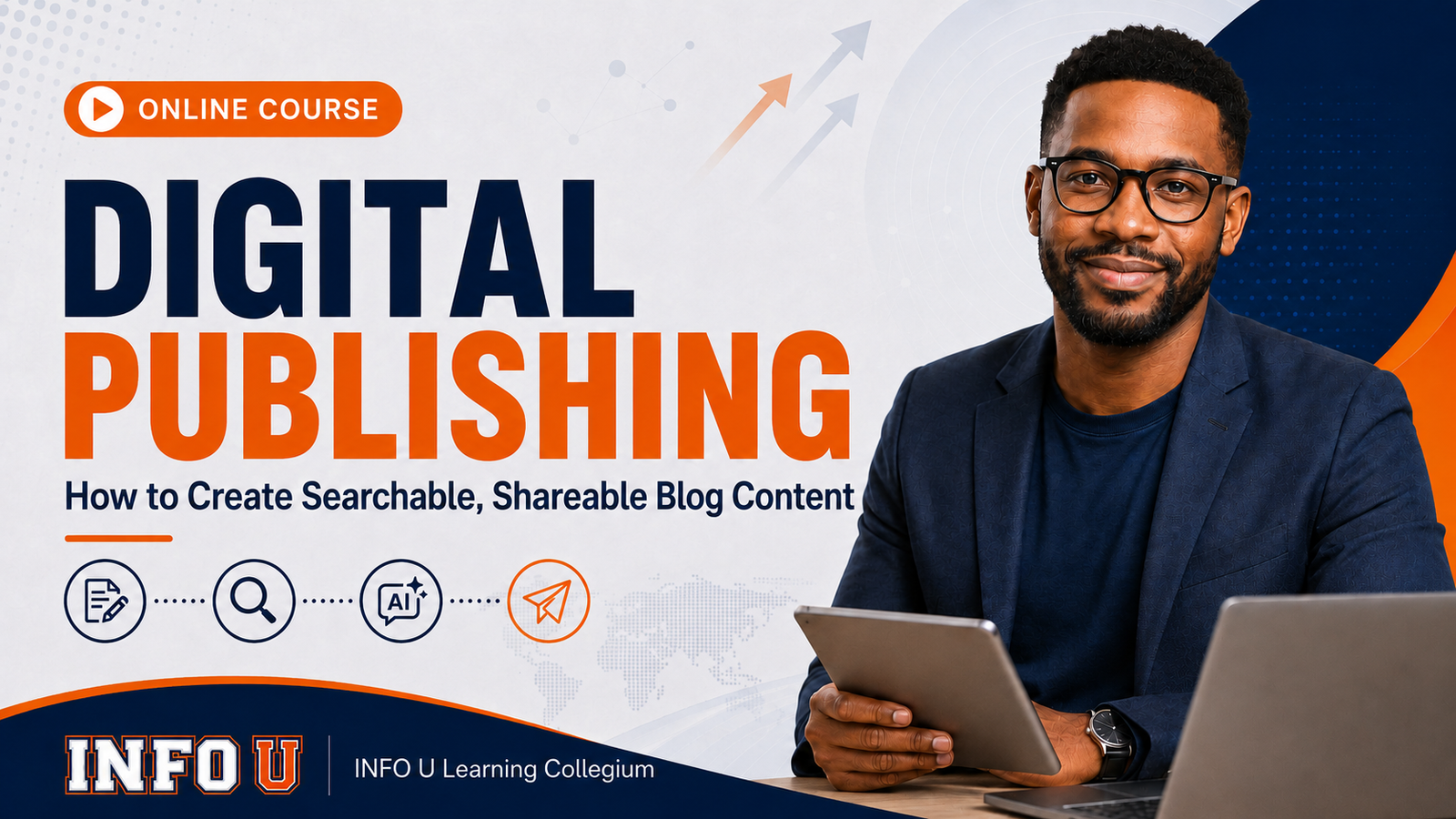
Your ideas cannot educate, influence, or create opportunities if people—and the digital tools they use—cannot discover them.
Digital publishing is more than uploading information to the internet. It is the process of transforming your knowledge, experiences, and ideas into organized digital content that can inform an audience, establish credibility, build a community, and continue producing value long after it is published.
Unlike a temporary social media post, a well-written blog article becomes a lasting digital asset. It can appear in Google search results, be shared across social platforms, answer questions for potential customers, and provide useful information to AI assistants and chatbots. Digital publishing gives individuals and organizations the ability to own their content, control their message, and build a searchable body of work.
This course introduces you to the importance of blogging and teaches you how to create an effective blog post using WordPress. You will learn how the different parts of a WordPress post work together—from the title and URL slug to categories, tags, images, share buttons, and search optimization.
A major portion of the course focuses on the anatomy of a properly structured blog post. You will learn how to organize an article so that it is easy for readers to follow, easy for search engines to understand, and easy for AI-powered platforms to reference when answering questions.
The course also introduces Search Engine Optimization, or SEO, and Answer Engine Optimization, or AEO. You will learn how traditional search engines such as Google evaluate content and how AI assistants, chatbots, and voice-search tools such as Siri and Google Assistant locate, interpret, and present information.
By the end of the course, you will understand how to move from an idea to a complete, polished, and publish-ready WordPress article.
In This Course, You Will Learn How To
- Understand the importance of digital publishing and why blogging remains a valuable tool for building visibility, authority, and trust.
- Set up the basic structure of a WordPress blog and understand the role of posts, pages, categories, tags, authors, and media.
- Create clear, compelling article titles that communicate the subject of the post and encourage people to continue reading.
- Write an effective introduction and organize the body of an article using sections, subheadings, short paragraphs, lists, and other readability tools.
- Create a clean, descriptive URL slug that helps readers and search engines understand what the article is about.
- Select the correct primary category and create focused tags that organize related content without producing unnecessary duplication.
- Choose and prepare an appropriate author profile image, featured image, and supporting images placed throughout the article.
- Understand the difference between WordPress tags, social media hashtags, categories, and keywords—and when to use each one.
- Configure social-sharing buttons, select featured content, and make an article easier for readers to share across different platforms.
- Apply fundamental SEO practices, including keyword placement, headings, image descriptions, links, metadata, and readable article structure.
- Apply AEO practices that make content easier for AI assistants, chatbots, and voice-search platforms to find, understand, summarize, and recommend.
- Publish and review a completed WordPress post using a repeatable quality-control checklist.
A Publishing System You Can Apply to Your Own Work
This is not a course about publishing content simply to say that you posted something. It is about developing a repeatable system for producing useful, professional, and discoverable content.
Throughout the course, you will examine the complete anatomy of a successful blog post. You will learn how every element serves a specific purpose. The title attracts attention, the introduction establishes relevance, subheadings organize the information, images support the message, and categories and tags connect the article to the rest of your website.
You will also learn how human readers, Google, and AI-powered search tools may approach the same article differently. Traditional SEO helps search engines properly index and rank your content. AEO focuses on providing clear, direct, and well-structured answers that AI systems and voice assistants can interpret when responding to questions.
The most effective articles serve both audiences. They are informative and engaging for people while also being clearly organized for the technologies that help people discover information.
You will use your own knowledge, business, organization, project, or area of interest as the foundation for the course assignments. This will allow you to create content that can be published and used immediately rather than completing an exercise that has no connection to your real work.
What You Will Create
By the end of the course, you will have completed:
- A WordPress Blog Structure Plan outlining your primary categories, supporting tags, author information, featured-content strategy, and basic publishing standards.
- A Searchable Article Blueprint identifying the article’s audience, purpose, central topic, important questions, keywords, section headings, and intended reader outcome.
- A Publication-Ready WordPress Blog Post containing an effective title, URL slug, introduction, structured body content, subheadings, primary category, focused tags, featured image, supporting images, and sharing options.
- An SEO and AEO Optimization Checklist covering search-friendly titles, metadata, keywords, image descriptions, links, direct answers, question-based sections, readability, and voice-search considerations.
- A Content Distribution Plan showing how the completed article can be shared through social media, hashtags, email, newsletters, and other digital channels.
You will finish the course with more than a single blog post. You will have a repeatable publishing process that can be used to produce future articles with greater clarity, consistency, and purpose.
Completing this course will help you move from simply posting information online to thinking and working like a digital publishing strategist—someone who understands how to create, organize, optimize, publish, and distribute content that people can find and use.
Curriculum
- 11 Sections
- 11 Lessons
- 10 Weeks
- Why Digital Publishing and Blogging MatterThis lesson explains what digital publishing and blogging are and why they remain important. Students will learn how blog posts become owned digital assets that build visibility, authority, trust, and long-term value while supporting discovery through search engines and AI platforms.1
- Understanding Blogging and Digital Publishing: What’s the Difference?1
- Developing Your Publishing StrategyStudents will identify the purpose of their blog, define their intended audience, and select subjects that meet their audience’s needs. They will also establish publishing goals and learn how to transform their knowledge, experiences, and ideas into useful content.1
- Setting Up Your WordPress BlogThis lesson introduces the WordPress dashboard and explains the difference between posts and pages. Students will configure basic blog and permalink settings, create their author profile, organize the media library, and prepare WordPress for consistent publishing.1
- The Anatomy of an Effective Blog PostStudents will examine the essential components of a properly structured blog post. They will learn how to create an effective title, write a strong introduction, organize the main content, use headings and subheadings, and conclude with a clear takeaway or call to action.1
- Categories, Tags, Slugs, and HashtagsThis lesson explains how to create a clean URL slug, select a primary category, and use focused tags to organize content. Students will also learn the differences between categories, tags, keywords, and social media hashtags.1
- Images and Visual PresentationStudents will learn how to select and format an appropriate featured image, author profile image, and supporting images for an article. The lesson also covers image placement, captions, titles, alternative text, and using visuals without distracting from the written content.1
- Search Engine Optimization for GoogleThis lesson introduces SEO and explains how search engines discover and evaluate content. Students will learn how to identify search intent, use keywords naturally, and optimize titles, headings, slugs, descriptions, links, images, and overall readability.1
- Writing for AI, Answer Engines, and Voice SearchStudents will learn how AI assistants, chatbots, and voice-search platforms interpret published content. They will practice using questions, direct answers, clear definitions, summaries, and conversational language to make articles easier for AI platforms and voice assistants to understand.1
- Publishing, Featuring, and Sharing Your PostThis lesson guides students through previewing, proofreading, scheduling, and publishing a completed WordPress post. Students will also learn how to feature an article, configure share buttons, and distribute content through social media, email, newsletters, and other digital channels.1
- Create and Publish Your Final Blog PostStudents will apply the complete publishing process by producing a searchable, shareable, and publication-ready WordPress article. The final post will include an effective title, slug, structured content, categories, tags, images, SEO and AEO improvements, sharing options, and a final quality review.1

Courses attributed to “The Collegium” are developed through the collective work of INFO U instructors, researchers, and course contributors. This designation is used when a course reflects the combined research, analysis, instructional design, and subject-matter contributions of multiple individuals rather than the work of a single author. Collegium contributors may help shape the course structure, lessons, case studies, learning objectives, instructional content, exercises, and knowledge or skills assessments. The Collegium designation may also be used when several contributors participate in developing or reviewing a course and an individual author credit would not fully represent the collaborative nature of the work.