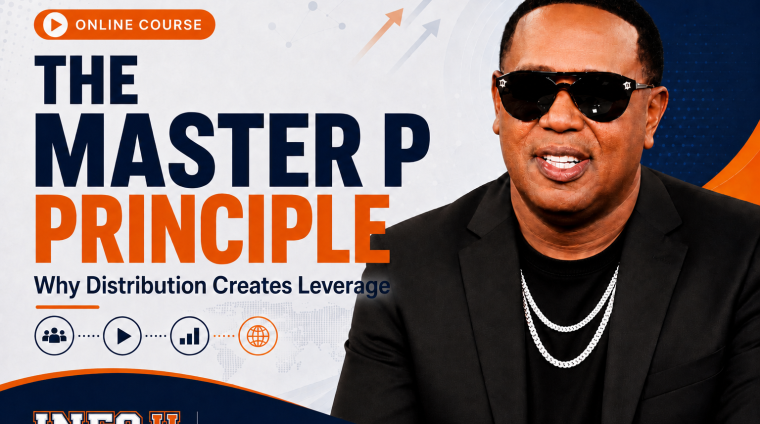
The Master P Principle — Why Distribution Creates Leverage
You can create something valuable and still remain powerless if someone else controls your access to the audience. The Master P Principle is a case-study-driven, AI-assisted course that examines how ownership and distribution helped Master P build an independent, multimillion-dollar empire in the record industry. His experience demonstrates a principle that extends far beyond music: when you control how your work reaches people, you gain greater control over your audience relationships, revenue opportunities, partnerships, timing, and long-term growth. The strategies explored in this course are transferable across creative media and traditional markets. Whether you are an artist, filmmaker, musician, author, podcaster, content creator, educator, entrepreneur, community leader, or organizational professional, this course will help you think differently about the systems connecting your work to the people it serves. Using Master P’s experience as the central case study, you will examine the difference between receiving attention on platforms you do not control and building a distribution system you can manage. You will learn how websites, independent communities, email lists, subscriber databases, membership programs, online stores, text messaging, and other direct channels can work together to create a stronger audience connection. You will also learn how to use social media strategically—as a place for discovery and visibility—without allowing it to become your only connection to your audience.
In This Free Course, You Will Learn How To
- Understand why controlling distribution creates greater strategic and financial leverage.
- Distinguish between an owned audience and the channels used to reach that audience.
- Recognize the risks of building entirely on rented third-party platforms.
- Identify the websites, communities, databases, memberships, and communication channels you meaningfully control.
- Build direct, permission-based relationships with subscribers, members, customers, supporters, and participants.
- Connect discovery, audience contact, value delivery, and feedback into a working distribution network.
- Use social media to move temporary attention toward an owned website, community, email list, store, or membership opportunity.
- Measure audience response and turn that information into proof of demand.
- Use audience access and proven demand to strengthen partnerships, revenue opportunities, negotiations, launches, and future growth.
- Transform the course principles into a focused 90-day implementation roadmap.
A Case Study You Can Apply to Your Own Work
This is not a course about copying Master P’s career or attempting to recreate the record industry of another era. It is about studying the strategic thinking behind his experience and identifying the principles that remain useful in today’s digital economy. Throughout the course, you will study original lesson graphics, review written explanations, and complete practical AI-guided assignments. An AI assistant will serve as a strategic thinking partner, helping you examine your current position, organize your ideas, identify weaknesses, and develop recommendations appropriate for your work and available resources. The AI will not create your strategy without your input. You will provide the knowledge, experience, goals, audience information, and evidence. The AI-guided prompts will help you turn that information into a clearer and more actionable plan.
What You Will Create
By the end of the course, you will have completed:
- An Audience and Distribution Audit identifying who you can reach directly and which communication channels you control.
- A Platform Dependency Audit showing where your work may be vulnerable to rented-platform rules, algorithms, or access restrictions.
- A Distribution Network Map connecting how people discover you, establish a direct relationship, receive value, and provide feedback.
- A Social-to-Owned Conversion Campaign designed to move interested people from social media into an environment you control.
- A Leverage Opportunity Brief connecting your audience access and proof of demand to one realistic partnership, launch, revenue, funding, sponsorship, or expansion opportunity.
- A personalized 90-Day Distribution Roadmap that identifies one priority, establishes practical milestones, defines success measurements, and gives you a specific action to begin within 48 hours.
You will leave this course with more than an understanding of why distribution matters. You will have a practical blueprint for strengthening the relationship between your work, your audience, and the systems that connect them. Creating value gets attention. Controlling distribution turns that attention into relationships, evidence, opportunity, and leverage.
Curriculum
- 8 Sections
- 8 Lessons
- 5 Hours
- The Master P Principle — 15 minutes1
- Why Distribution Matters — 15 minutes1
- Owned Audience vs. Owned Distribution — 15 minutes1
- Rented Platforms vs. Owned Platforms — 20 minutes1
- Building Your Distribution Network — 25 minutes1
- Use Social Media—Don't Depend on It — 15 minutes1
- Turning Distribution Into Leverage — 25 minutes1
- From Strategy to Action — Your 90-Day Distribution Roadmap1

Courses attributed to “The Collegium” are developed through the collective work of INFO U instructors, researchers, and course contributors. This designation is used when a course reflects the combined research, analysis, instructional design, and subject-matter contributions of multiple individuals rather than the work of a single author. Collegium contributors may help shape the course structure, lessons, case studies, learning objectives, instructional content, exercises, and knowledge or skills assessments. The Collegium designation may also be used when several contributors participate in developing or reviewing a course and an individual author credit would not fully represent the collaborative nature of the work.